
Dentures can become looser over time, while the denture itself hardly changes shape. This is often because the jawbone and gums continue to change. By relining the dentures — also rebase or reline — the inside can be made to fit again.
Relining is not a standard solution for every loose denture. That is why we first examine the mouth, the fit, the bite, wear and the condition of the denture. Sometimes a relining helps; sometimes it is wiser to adjust, repair or replace.
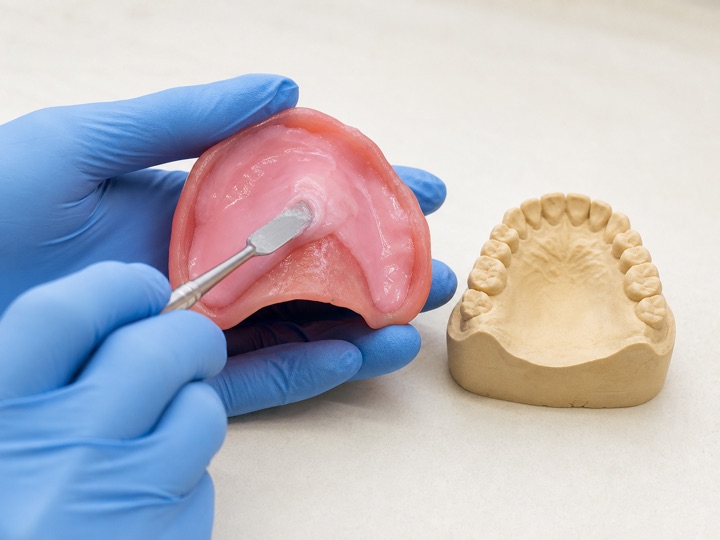
What does relining mean?
With a relining, the existing teeth and molars of the prosthesis are retained. New material is applied to the underside — the pink part that rests on the jaw. In this way we fill the space created by changes or shrinkage of the jaw.
The goal is for the prosthesis to fit better again, the chewing forces to be distributed more evenly and to reduce movement or tilting. Relining usually does not change the visible tooth position or color. If the teeth, bite or appearance are no longer good, a new denture may be more suitable.
From space under the prosthesis to a better connection
The jaw changes
Space is created between the mucous membrane and dentures.
Impression in the prosthesis
Your current mouth shape is accurately recorded.
New lining
The inside receives a suitable layer of synthetic resin.
Try-in and check
Fit, edges, bite and pressure are reassessed.
Why do dentures loosen?
After tooth extraction, the jawbone changes. This can happen quickly, especially in the first year, but the change does not stop completely after that. A hard prosthesis does not automatically change. This allows space to be created and the dentures to move.
Other possible causes are wear of the teeth, a changed bite, a dry mouth, less muscle control, weight loss, illness, damage to the prosthesis or wear of click parts. With implant-retained removable dentures, the problem may be in the fit, but also in locators, matrices, clips, stud attachments or a bar construction.
Signs that a check-up is advisable
- The dentures move, tilt or come loose when talking or eating.
- You need more and more adhesive.
- Food gets under the prosthesis.
- You get recurring pressure sores, wounds or irritation.
- The chewing force feels unevenly distributed.
- Your lower denture slides forward or to the side.
- The prosthesis clicks or taps while talking.
- Your face, lip support, or bite seems to change.
- Implant-retained removable dentures click into place less firmly than before.
Loose dentures do not automatically mean that relining is necessary. First it must be clear where the problem comes from.
When can relining be a suitable solution?
Relining may be appropriate when the prosthesis is still technically sound, the tooth position and bite are usable and, above all, space has been created under the base. This often occurs with an immediate denture during the healing process, but also with an older complete denture that is otherwise in good condition.
A partial plate denture or implant-retained removable denture can also sometimes be filled. Additional assessment is required for a frame prosthesis, prosthesis on its own roots or implant-supported prosthesis because metal parts, teeth, roots, implants and attachment parts influence the treatment.
Direct or indirect relining
Direct relining
In direct relining, the lining material is placed in or on the denture and made to fit in the mouth. This may be suitable as a quick or temporary solution. The result, material and expected useful life depend on the situation. A soft lining can provide temporary comfort during healing or for sensitive mucous membranes, but is usually not a permanent final solution.
Indirect relining
For indirect relining, we use your denture as an impression tray. Impression material records the current shape of the jaw and, where needed, the borders accurately. A new hard acrylic layer is then applied in the laboratory. The denture is finished, polished, refitted and checked.
The indirect method usually produces an accurate, durable liner. Often the work can be done the same day, but planning, technique and oral situation may mean that you have to do without dentures for longer. We always agree this with you in advance.
Tissue conditioner and softliner: what's the difference?
Both are soft materials on the inside of dentures. In practice, the terms are sometimes used interchangeably, but they do not always mean the same thing. One tissue conditioner is a temporary form of soft liner. A softliner is the broader name for a soft, resilient lining material and can be used temporarily or longer term.
Tissue conditioner
A very soft layer that can temporarily provide rest and support to irritated or vulnerable mucous membranes.
- Often after tooth extraction or implant placement.
- Also for pressure points or damaged mucous membrane.
- At first it adapts somewhat to the mouth.
- Intended for weeks to several months; checking and replacement may be necessary.
Softliner
A softer, resilient liner that can cushion chewing pressure when hard material is too stressful.
- Can be applied directly or in the laboratory.
- May be suitable for very sensitive or thin mucous membranes.
- Does not last indefinitely: material can harden, discolour, become rough or peel off.
- Requires careful cleaning and periodic inspection.
Hard relining
The inside is permanently adapted to the current shape of the jaw with hard synthetic resin.
- Provides a precise and smooth finish.
- Is not resilient and does not cushion pressure like a soft liner.
- Often the next step after the mouth and jaw have sufficiently recovered.
- Not suitable if the mucous membrane needs to calm down first.
When do we choose a tissue conditioner?
A tissue conditioner can be an intermediate step when the mucous membrane is red, painful or damaged and a hard relining is not yet wise. The soft material temporarily distributes the pressure and can help the prosthesis fit better during a rapidly changing healing phase. This can happen, for example, with an immediate denture, after extractions, around an implant procedure or with recurring pressure points.
The layer deliberately ages faster than hard denture plastic. Over time it can become porous, harder, rough or less hygienic. That is why we agree on a check time. Depending on the recovery, the layer can be renewed, removed or later replaced with a hard relining or a new prosthesis.
When can a softliner be used longer?
Some patients have long-term very thin, fragile or sensitive mucous membranes or a jaw shape on which a hard base exerts a lot of pressure. Then a more durable softliner can be considered. The pros and cons must be carefully weighed: a soft layer may be more comfortable, but is usually more sensitive to wear, discoloration, odor, tarnish and damage than hard synthetic resin.
A more durable softliner should also be assessed periodically. “Permanent” for this material does not mean that it never needs to be replaced.
Cleaning a soft liner
- Use the cleaning agents and method we recommend for your specific material.
- Clean the soft side gently with a soft brush; hard scrubbing can damage the surface.
- Do not use toothpaste, abrasives, bleach, boiling water or aggressive cleaners.
- Do not pull on loose edges and do not cut or file the material yourself.
- Rinse away food residues after meals and also clean your oral mucosa.
- Contact us if the lining becomes loose, tears, hardens, becomes very discolored, smells unpleasant or causes new pain.
The appropriate care varies by product. The individual instructions you receive when it is fitted therefore always take precedence over general information.
Source and further explanation: KNMT – soft tissue conditioner.
How does the appointment proceed?
- Discussion and examination. We discuss your complaints and examine the mouth, mucous membrane, prosthesis, edges, bite, wear and tear and any implants.
- Choice of solution. You will hear whether relining is wise, which type of relining is suitable and what alternatives are.
- Cost estimate and reimbursement. We explain costs, possible patient contribution and possible permission in advance.
- Impression. For indirect relining, we take an impression inside your existing denture. We may use border moulding to record muscle attachments and denture borders accurately.
- Laboratory phase. The impression material is replaced with new synthetic resin and the prosthesis is given a smooth finish.
- Fit and check. We check the connection, edges, bite and movements of lips, cheeks and tongue.
- Aftercare. If a pressure point occurs, we adjust the prosthesis locally. Do not file or sand yourself.
Relining an immediate denture
After extraction, the jaw and gums change rapidly. As a result, an immediate denture can loosen in a short time. A temporary soft lining or relining can improve the fit during healing. Later we will assess whether another relining is sufficient or whether a new, more definitive prosthesis fits better.
Read more about the emergency or immediate prosthesis.
Relining implant-retained removable dentures
Implant-retained removable dentures do not only rest on implants or a bar; parts of the prosthesis also rest on the mucous membrane. When the jaw changes, relining may be necessary to properly distribute the load again. At the same time we check implant tissue, bars or stud attachments and the plastic clips or matrices. Just replacing rings or clips is different from relining the prosthesis.
Implant-retained removable dentures may not be filled in an uncontrolled manner. The implant position and click system must be accurately registered so that no harmful tension is created.
When is relining not enough?
A new prosthesis or other treatment may be more sensible when:
- the teeth and molars are severely worn;
- the bite or bite height is no longer correct;
- the prosthesis breaks repeatedly or is seriously damaged;
- the base is severely deformed or extended several times;
- the tooth position, appearance or lip support is no longer appropriate;
- there is insufficient space to safely apply new material;
- an implant, root or click system needs to be examined or treated;
- the complaints are not caused by space under the prosthesis.
Relining does not make a worn prosthesis new. That is why we always assess the entire denture and not just the loose fit.
After relining
The prosthesis may initially feel tighter or different. Your tongue, cheeks and chewing muscles sometimes have to get used to it again. Slight tenderness may occur, but a sharp pressure spot, wound or increasing pain should be checked.
- Follow the wearing advice you receive when installing.
- Eat slowly for the first few hours, starting with softer foods if necessary.
- Clean dentures according to usual instructions.
- Do not use excess adhesive to mask a painful fit.
- Insert the dentures for some time before a check-up, unless this is really not possible due to pain; This way we can better recognize the pressure point.
- Never adjust the denture yourself with a file, sandpaper, hot water or DIY materials.
Costs and reimbursement
Netherlands
A relining of removable complete dentures is covered by basic insurance under certain conditions. In 2026, a statutory patient contribution of 10% of the costs applies to repair and relining of removable complete dentures. In addition, the deductible may apply. Different rules apply to a partial plate prosthesis or frame prosthesis. With implant-retained removable dentures, consent, contracting and the age of the facility can have an influence.
Belgium
The Belgian reimbursement depends on the type of prosthesis, the provision carried out, the conditions of the RIZIV and your health insurance company. Because the treatment takes place in the Netherlands, we recommend having a cost estimate assessed in advance and confirming in writing what will be reimbursed.
- View the detailed explanation for the Netherlands.
- View the explanation about reimbursement in Belgium.
Frequently Asked Questions
How often can dentures be relined?
There is no fixed medical number. It depends on the condition and age of the denture, the amount of space, previous adjustments and the bite. After several rebasings, a new prosthesis may be more effective or technically better.
Will my teeth look different after relining?
No. With a normal relining, the existing teeth, tooth position and visible outside are usually preserved. Only the inside is adjusted.
Can relining repair a broken denture?
A fracture must first be safely repaired and the cause investigated. Sometimes repair and relining are combined, but repeated breakage may indicate improper fit, insufficient space, material fatigue, or a distorted bite.
Can I wait if the dentures are only a little loose?
It is better to have it checked before wounds, fractures or additional jaw shrinkage occur. A check-up does not automatically mean that immediate treatment is required.
Would you like to know whether relining helps you?
Take your dentures with you and tell us what you notice when eating, speaking and laughing. We first investigate the cause and then calmly explain whether relining, adjusting, repairing or replacing makes the most sense.
Make an appointment or request a call back.
Reliable sources of information
- KNMT – relining
- KNMT – explanation of border moulding
- National government – statutory patient contributions 2026
This general patient information was checked on August 4, 2026 and does not replace personal examination or treatment advice.