
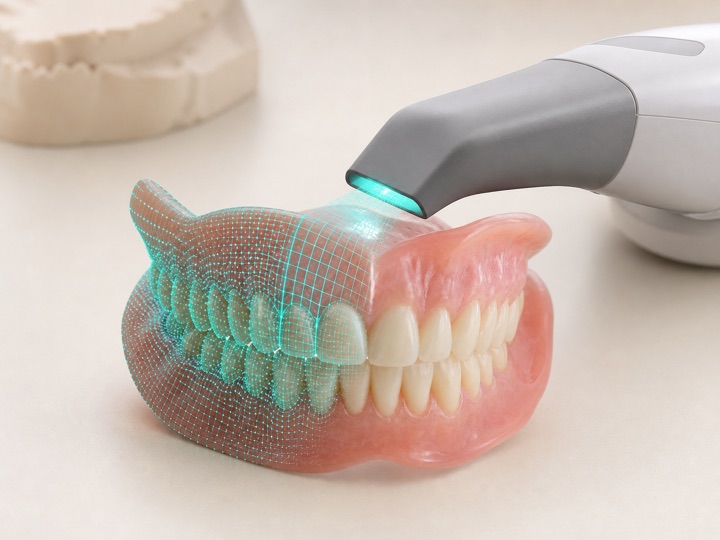
“Do I need to have impressions taken?” is a question we often hear. By taking dental impressions patients usually mean that we take an impression of the mouth with a impression tray and impression material. Nowadays we can often digitally record a dental situation with a intraoral scanner. Both techniques have the same goal: to make an accurate copy of teeth, implants, jaw and mucous membrane.
A scan is not automatically better than a conventional impression. For complete dentures in particular, mobile oral tissues, muscle attachments and the length of denture borders matter. Impression material can sometimes record this functional shape better. We therefore choose an impression, scan or combination for each patient.
Why must the mouth be captured?
An impression or scan may be required for a complete denture, plate denture, frame denture, implant-retained removable denture, repair, relining, implant provision or digital treatment design. The registration shows, among other things:
- the shape of the jaw and mucous membrane;
- the location and shape of existing teeth and molars;
- the position of implants or scan components;
- the available space for a prosthesis;
- how the upper and lower jaws fit together;
- where the borders, small tissue attachments and muscle attachments are located.
The registration of the shape is not the same as a bite registration. During a bite assessment, we determine how the jaws are positioned in relation to each other and at what height the teeth and molars should be.
Regular impression or digital mouth scan
Impression with a tray and impression material
A suitable impression tray with soft material is placed briefly in the mouth. After curing, an accurate negative shape of the mouth is created.
- Can record teeth, jaw and soft tissues.
- Suitable for functional border moulding.
- May be necessary for complete dentures and mobile mucosa.
- The impression is used to create a model or digital file.
Intra-oral scan
A small scanning head is moved gently through the mouth. Many separate images are immediately combined into a three-dimensional model on the screen.
- No impression tray or hardening material.
- Missing parts can be rescanned immediately.
- The digital model can be checked directly.
- The scan uses light and is not an X-ray examination.
How a conventional impression is taken
- Choosing the appropriate impression tray. We first try an impression tray of sufficient size that does not exert unnecessary pressure.
- Applying impression material. We usually use alginate for an initial impression or a more precise elastic material for a final impression.
- Inserting the impression tray. We guide lips and cheeks and ask you to breathe calmly through the nose.
- Please wait. The material must harden briefly. We always tell you how long it will take.
- Remove and check. The impression tray is removed with a controlled movement. We check that all important areas have been recorded accurately.
- Repeat if necessary. An air bubble, missing edge or movement may indicate a need for a new impression.
First and final impressions
For complete dentures, we may first take a preliminary impression with a standard tray. We then use the resulting model to make a custom tray for your mouth. This tray can be used to take the final precision impression.
When taking the final impression, we can carry out border moulding. By asking you to move your lips, cheeks and tongue, we record how long and thick the denture borders can be without interfering with muscles and small tissue attachments. This helps with retention, stability and comfort.
This is how an intra-oral scan works
- Prepare. We ensure that the surfaces to be scanned are as visible as possible and not too wet.
- Scanning. The scanning head moves step by step along teeth, jaw, mucous membrane or scanning parts.
- Watch live. A colored three-dimensional image is immediately created on the screen.
- Replenish. A missed section can be re-captured locally without redoing the entire scan.
- Register bite. If necessary, the practitioner scans part of both dental arches with the mouth closed to record the mutual position.
- Check and save. The file is under review and can be used for design, comparison, or communication with the laboratory.
Is a mouth scan the same as an x-ray?
No. An intra-oral scanner uses cameras and light to create a digital image of visible surfaces. The scan does not show roots in the jaw bone, nerves, inflammation or bone volume as X-ray examination can. If information is required under the gums or in the bone, separate X-ray examination may be advised.
What if you gag easily?
Tell this before the treatment. We take our time, choose the impression tray and amount of material carefully and agree on a clear stop signal. Sitting upright, breathing calmly through your nose and knowing what is happening often helps. A digital scan may be more comfortable for some people, but the scanning head must also be able to reach the back of the mouth.
If you have a very blocked nose, are nauseous or do not feel well, please let us know in advance. We will then look together at what is sensible.
Does taking an impression or scan hurt?
A registration should not cause sharp pain. Pressure, feeling of fullness, salivation or a tendency to gag may occur. Report sensitive areas, wounds, loose teeth or recently placed implants in advance. We stop when necessary and adjust the technology.
When do we choose a combination?
In a completely edentulous jaw, soft tissues can change shape during pressure and movement. A scan mainly records the situation as it is visible at that moment. A functional impression can actually capture how cheeks, lips and tongue influence the denture edges. Therefore, for example, an initial scan can be combined with a conventional final impression.
We can also scan an existing denture outside the mouth, digitize a conventional impression or scan a model in the laboratory. Working digitally does not mean that every step necessarily takes place with a scanner in the mouth.
Our scanners have different tasks
- SHINING 3D Aoralscan Elite: intra-oral scanner for registration in the mouth, including teeth, jaw shapes and certain implant positions.
- 3Shape F8: laboratory scanner for digitizing impressions, models and prosthetic workpieces outside the mouth.
- SHINING 3D MetiSmile: facial scanner that can register the shape and proportions of the face as additional information for design and communication.
- 3Shape design software: uses the digital data for analysis and design of a prosthetic device.
View our complete digital working method and equipment.
Impressions for implants and implant-retained removable dentures
For implants, we need to record both the shape of the oral tissues and the position of the implants or attachment components accurately. Scan bodies, impression components or photogrammetry may be used. The appropriate method depends on the number of implants, the system, the treatment stage and the intended restoration.
An existing click prosthesis, bar or locator may not influence the registration in an uncontrolled manner. That is why the practitioner checks in advance which parts should remain in place, be removed or scanned separately.
Can a scan save an appointment?
Sometimes a digital registration can be more efficient or can be easily supplemented. However, digital does not automatically mean that fewer appointments are needed. For a good denture, assessment of fit, bite, aesthetics, speech, fitting and aftercare remain important. The number of contact moments depends on your oral situation and treatment plan.
Costs and reimbursement
A necessary impression or scan is usually part of the proposed treatment process. The billing and reimbursement depend on the type of prosthesis, the performance code used, insurance or health insurance and any permission. You will receive a cost estimate in advance when necessary.
Frequently Asked Questions
Does an impression always need to be repeated if I move?
Not every small movement makes a impression unusable. We check the important surfaces, edges and details. We only make another impression when information is missing or distorted.
Can I see the digital scan myself?
Yes, usually we can show the three-dimensional image directly on the screen and explain which parts are registered.
Will my scan data be saved?
Data that are part of your treatment are processed in accordance with the rules for the patient file and privacy. Digital files are only used and shared for your care, administration or legal obligations.
Can everyone be scanned?
Many situations can be captured digitally, but a limited mouth opening, a lot of saliva, mobile tissue, deep edges or a complex implant construction may require a different or combined method.
Reliable sources of information
- KNMT – explanation of a dental impression
- KNMT – individual precision impression for complete dentures
- SHINING 3D – technical information Aoralscan Elite
This general patient information was checked on August 4, 2026 and does not replace personal assessment or treatment advice.
Would you like to discuss in advance what you like?
Do you have a strong gag reflex, previous unpleasant experiences or fear of an impression? Please indicate this when making the appointment. We explain in advance what we are doing and, where possible, choose the method that suits your mouth and treatment.